
Timings: Sunrise to Sunset (6AM TO 6PM)
Closed on Friday.
Time Required: 2 hours
Entry Fee: Indian Citizens and Visitors from SAARC countries: INR 50
Citizens of SAARC and BIMSTEC Countries: INR 540
Foreign Visitors: INR 1100
(Additional INR 200 for every tourist who wishes to enter the mausoleum)
Entry is free for all children below 15 years
How to Reach Taj Mahal:
Nearest Airport to Taj Mahal: The nearest airport to Taj Mahal is Agra Airport at a distance of 13 km and will take 35 minutes to reach the monument by a taxi from the airport.
Nearest Railway Station to Taj Mahal: The closest railway station is Agra Cantt at a distance of 6 km. It is about 13 minutes drive via an auto or cab from the railway station.
Nearest Bus Stand to Taj Mahal: The Idgah Bus Station is the biggest and most prominent bus terminal in Agra and is 6 km from the Taj Mahal. You can hire a taxi or hail an auto to reach the monument from there. It takes approx 15 minutes. You can also hire a rickshaw puller to reach Taj Mahal from the bus station.
By Road: If you are coming from Delhi NCR by road, you can take the Yamuna Expressway connecting Greater Noida with Agra; it is a 165 km drive.
Taj Mahal Address: The Taj Mahal is located in Dharmapuri, Forest Colony, Tajganj, Agra, Uttar Pradesh – 282001.
Other details about Online Ticket Booking, Accomodation, Other Things to do in Agra etc are mentioned below in the blog
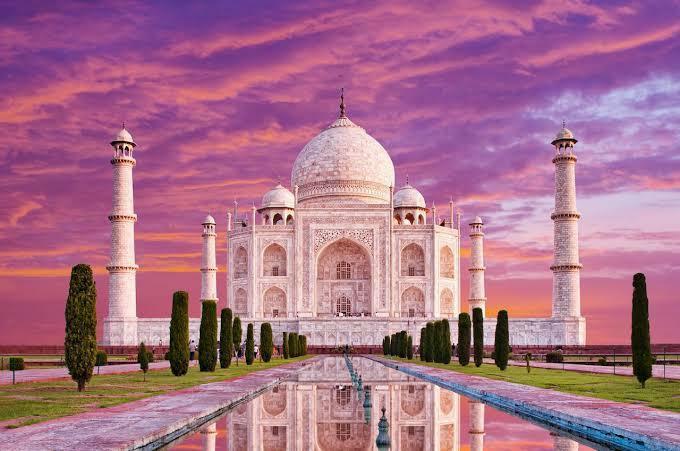
The Taj Mahal is an enormous mausoleum complex commissioned in 1632 by the Mughal emperor Shah Jahan to house the remains of his beloved wife. Constructed over a 20-year period on the southern bank of the Yamuna River in Agra, India, the famed complex is one of the most outstanding examples of Mughal architecture, which combined Indian, Persian and Islamic influences. At its center is the Taj Mahal itself, built of shimmering white marble that seems to change color depending on the daylight. Designated a UNESCO World Heritage site in 1983, it remains one of the world’s most celebrated structures and a stunning symbol of India’s rich history.
Shah Jahan
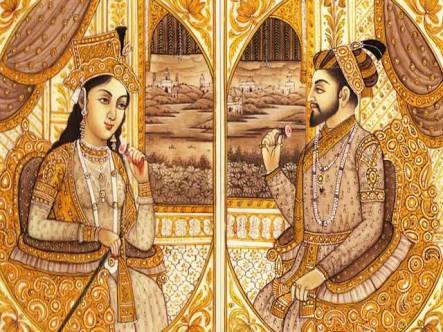
Shah Jahan was a member of the Mughal dynasty that ruled most of northern India from the early 16th to the mid 18th-century. After the death of his father, King Jahangir, in 1627, Shah Jahan emerged the victor of a bitter power struggle with his brothers, and crowned himself emperor at Agra in 1628.
At his side was Arjumand Banu Begum, better known as Mumtaz Mahal (“Chosen One of the Palace”), whom he married in 1612 and cherished as the favorite of his three queens
In 1631, Mumtaz Mahal died after giving birth to the couple’s 14th child. The grieving Shah Jahan, known for commissioning a number of impressive structures throughout his reign, ordered the building of a magnificent mausoleum across the Yamuna River from his own royal palace at Agra.
Construction began around 1632 and would continue for the next two decades. The chief architect was probably Ustad Ahmad Lahouri, an Indian of Persian descent who would later be credited with designing the Red Fort at Delhi.
In all, more than 20,000 workers from India, Persia, Europe and the Ottoman Empire, along with some 1,000 elephants, were brought in to build the mausoleum complex.

Layout And Architecture
Resting in the middle of a wide plinth 23 feet (7 metres) high, the mausoleum proper is of white marble that reflects hues according to the intensity of sunlight or moonlight. It has four nearly identical facades, each with a wide central arch rising to 108 feet (33 metres) at its apex and chamfered (slanted) corners incorporating smaller arches. The majestic central dome, which reaches a height of 240 feet (73 metres) at the tip of its finial, is surrounded by four lesser domes. The acoustics inside the main dome cause the single note of a flute to reverberate five times. The interior of the mausoleum is organized around an octagonal marble chamber ornamented with low-relief carvings and semiprecious stones (pietra dura). Therein are the cenotaphs of Mumtaz Mahal and Shah Jahan. Those false tombs are enclosed by a finely wrought filigree marble screen. Beneath the tombs, at garden level, lie the true sarcophagi. Standing gracefully apart from the central building, at each of the four corners of the square plinth, are elegant minarets.
Flanking the mausoleum near the northwestern and northeastern edges of the garden, respectively, are two symmetrically identical buildings—the mosque, which faces east, and its jawab, which faces west and provides aesthetic balance. Built of red Sikri sandstone with marble-necked domes and architraves, they contrast in both colour and texture with the mausoleum’s white marble.
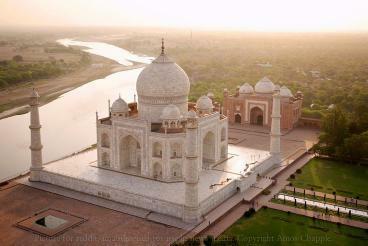
The garden is set out along classical Mughal lines—a square quartered by long watercourses (pools)—with walking paths, fountains, and ornamental trees. Enclosed by the walls and structures of the complex, it provides a striking approach to the mausoleum, which can be seen reflected in the garden’s central pools.
The southern end of the complex is graced by a wide red sandstone gateway with a recessed central arch two stories high. White marble panelling around the arch is inlaid with black Qurani lettering and floral designs. The main arch is flanked by two pairs of smaller arches. Crowning the northern and southern facades of the gateway are matching rows of white chhattris (chhattris; cupola-like structures), 11 to each facade, accompanied by thin ornamental minarets that rise to some 98 feet (30 metres). At the four corners of the structure are octagonal towers capped with larger chattris.
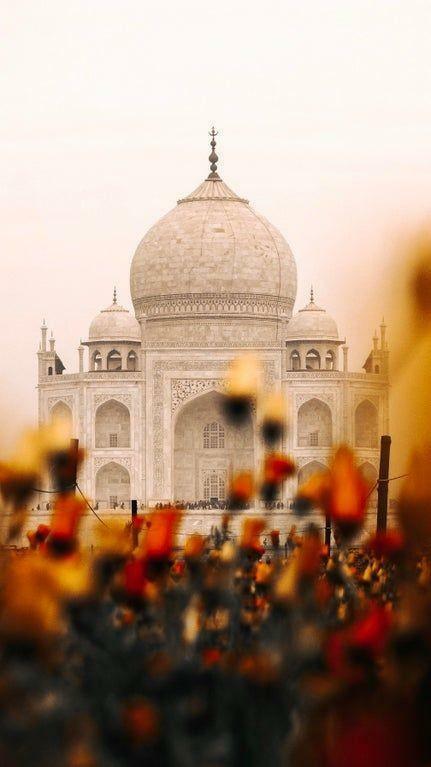
Two notable decorative features are repeated throughout the complex: pietra dura and Arabic calligraphy. As embodied in the Mughal craft, pietra dura (Italian: “hard stone”) incorporates the inlay of semiprecious stones of various colours, including lapis lazuli, jade, crystal, turquoise, and amethyst, in highly formalized and intertwining geometric and floral designs. The colours serve to moderate the dazzling expanse of the white Makrana marble. Under the direction of Amanat Khan al-Shirazi, verses from the Quran were inscribed across numerous sections of the Taj Mahal in calligraphy, central to Islamic artistic tradition. One of the inscriptions in the sandstone gateway is known as Daybreak (89:28–30) and invites the faithful to enter paradise. Calligraphy also encircles the soaring arched entrances to the mausoleum proper. To ensure a uniform appearance from the vantage point of the terrace, the lettering increases in size according to its relative height and distance from the viewer.
Taj Mahal Quick Facts
– A 1000 elephants were used to transport building materials for the construction of the Taj.
– The brilliant white marble came in from Makrana in Rajasthan, the jade and crystal came from China, the jasper from Punjab, the turquoise from Tibet, the Lapis Lazuli from Afghanistan, the carnelian from Arabia and the sapphire from Sri Lanka.
– The famous inlay work on the marble has about 28 varieties of precious and semi-precious stones.
Taj Mahal Timings & Entry Gates
Taj Mahal Western Gate:
To enter through this gate, you can buy the tickets near Saheli Burj. Opening hours for this gate are an hour before sunrise and about 45 minutes prior to sunset. This is actually the main entrance to the mausoleum and looks out to the Agra Cantt and the city at large. Outside this gate, don’t miss the beautiful red sandstone structure ‘Fatehpur Begum’, dedicated to another of Shah Jahan’s wives. Sprawled out across an open terrace, the courtyard of the building is fit to accommodate about 200 people at a time who wish to offer Namaz.
Taj Mahal Eastern Gate:
The tickets are available at this gate itself. Again, the visiting hours remain the same; an hour before sunrise, and 45 minutes before sunset. Facing Fatehbad, there is a domed tomb here nestled on an elevated plinth, also known as ‘Sirhi Darwaza’. This too is a tomb to another of Shah Jahan’s wives, Sirhindi begum. The main structure is an architectural marvel what with its 24 arches, a giant hall and courtyard, and built in a unique eight-sided style.
Taj Mahal Southern Gate:
You can only exit from this gate; no entry is allowed. Meant for pedestrians alone, this gate faces the old town, Mumtazabad. There is a tomb here too of red sandstone complete with a rambling courtyard and a dome. The grave is believed to be of a maid of Mumtaz Mahal’s who always kept her company and looked after her.
Be apprised of the fact that there are separate queues for domestic and foreign tourists.
Taj Mahal Over the Years
Under Aurangzeb’s long rule (1658-1707), the Mughal empire reached the height of its strength. However, his militant Muslim policies, including the destruction of many Hindu temples and shrines, undermined the enduring strength of the empire and led to its demise by the mid-18th century.
Even as Mughal power crumbled, the Taj Mahal suffered from neglect and disrepair in the two centuries after Shah Jahan’s death. Near the turn of the 19th century, Lord Curzon, then British viceroy of India, ordered a major restoration of the mausoleum complex as part of a colonial effort to preserve India’s artistic and cultural heritage.
Today, some 3 million people a year (or around 45,000 a day during peak tourist season) visit the Taj Mahal.
Air pollution from nearby factories and automobiles poses a continual threat to the mausoleum’s gleaming white marble facade, and in 1998, India’s Supreme Court ordered a number of anti-pollution measures to protect the building from deterioration. Some factories were closed, while vehicular traffic was banned from the immediate vicinity of the complex.
Taj Mahal Night Viewing Tickets
The entry tickets for night viewing can be bought 24 hours in advance. You can buy the tickets from the Archaeological Survey of India office on Agra Mall Road between 10:00 am and 06:00 pm. The price for an adult Indian tourist is INR 510, and for an international tourist is INR 750. Children between 3 and 15 years need to pay INR 500 to gain entry.
However, at a time a total of 400 tourists are allowed inside the Taj complex. These 400 are further categorised in eight batches with 50 members each. Nighttime viewing of the Taj is available only five days a month on a full moon night and two days ahead and two days post the full moon, with the exception of Fridays. The night visit duration is 30 minutes between 08:30 pm and 12:30 am.
Taj Mahal Tickets Online
You can book your online ticket from the Archaeological Survey of India website, which gives you a list of monuments under ASI whose tickets you can book. Select the monument, enter your name, age, gender, the type of ID proof you are offering, from passport, Aadhaar card, driving license to voter’s card, including the unique ID number. A maximum of 20 adults and 10 children are allowed per booking. Head to the payment gateway, enter card details and confirm your booking. The e-ticket will be sent to your email id. You then need to take a print out of the ticket and keep the same for producing at the entry gate. You can get a discount of INR 5 per Indian ticket, and INR 50 per international tourist ticket if you book online.
There are ample accommodation options available in Agra with some really exclusive properties around the Taj such as the Amar Vilas on the Eastern Gate, Mughal Sheraton on Fatehabad Road, Trident Hilton, among a string of conveniently located budget hotels and guest houses. Little wonder, Taj Mahal is a great excursion for a cross-section of travellers from within the country and even outside.
Other Monuments in Agra
Some of the other monuments in Agra are Mehtab Bagh, Mariam’s Tomb, Itimad-ud-Daulah Tomb, Ram Bagh and Akbar’s Tomb.
Hotels Near Taj Mahal
Some hotels near Taj Mahal are Four Points by Sheraton Agra, Orient Taj Hotel and Resorts, Crystal Sarovar Premiere – A Sarovar Hotel, Jaypee Palace Hotel & Convention Centre Agra and Hotel Parador Agra.
Things to Do in Agra
Some of the major things to do in Agra are shopping at the Shilpigram market area, taking the Mughal heritage walk, and watching the light and sound show at Kalakriti Cultural And Convention Center.
Stay tuned for more information about the travel destinations and don’t forget to follow our social media handles !
Thank You !
Team Travelographer

 Travelographer