

Elephanta Caves Timings: 9:30am to 5:30pm.
Closed on Mondays.
Ferry Timings:
From Gateway of India to Elephanta Caves: 9am to 2pm. (Every half an hour)
From Elephanta Caves to Gateway of India: 12pm to 5:30pm (Every half an hour)
Ferry Services are closed on Mondays.
Ferry Charges: ₹150 for two way trip.
Address: Elephanta Island, Gharapuri, Mumbai Harbour, Maharashtra 400094
How to Reach Elephanta Caves: To get to the Elephanta Island, you need to take a ferry from the Gateway of India jetty. The ferry charges around INR 150 for a Career across the bay towards Mumbai Harbour for an hour and then you will arrive at Gharapuri or the Elephanta Island. From here you can either walk the one kilometre distance from the harbour to the base of the western hill, home to the Grand Cave, or take a toy train to the site. The toy train charges ₹10 per person. Further, there is a climb of 120 steps to the entrance of Cave 1.
Nearest Bus Stand: There are two city buses, 111 and 112 that depart from Mumbai CST and Ahilyabai Holkar Chowk respectively and drop you at the Gateway of India. To get to the Elephanta Island, further board the ferry from the Gateway of India jetty.
Nearest Railway Station: To get to the Elephanta Caves you need to arrive at the Gateway of India first, from where it is a ferry ride away. The railway station nearest to the Gateway of India is Churchgate and the Chhatrapati Shivaji Maharaj Terminus, a very prominent south Mumbai address. From the railway station, the Gateway of India is a mere two-kilometres which can be covered by a taxi.
Nearest Airport: Chhatrapati Shivaji International Airport serves Mumbai and has a brilliant network with the capital of the country and other metro cities aside from having great international connectivity. You have frequent direct flights from Delhi, Bangalore, Hyderabad, Chennai, Jaipur, Ahmedabad, and Kolkata to Mumbai.
Entry Fees:
Indian Citizens – ₹40
SAARC & BIMSTEC – ₹40
Foreigners – ₹600
Free for childern below the age of 15
To avoid last minute hustle, it is advisable to book your Elephanta Caves ticket from the web, and simply present yourself at the venue. The Archeological Survey of India website also allows for online ticket booking of the Elephanta Caves.
Best Time to Visit: While Elephanta is a year-round destination, it is best to avoid the monsoon months between June and August because torrential rains can derail boat schedules, besides choppy waters may not be the most ideal to venture into. The weather will be your friend between November and February, even early March, and is better suited to walk about and explore the sculptures at Elephanta.
The Elephanta Festival: February is the month for the two-day Elephanta festival which experiences an explosion of cultural activities from classical dance performances, musical recitals, theatre renditions, and not to mention, performances by folks from the local Koli fishing community. With a dramatically lit up Trimurti sculpture in the backdrop, the ambiance in the pillared portico of the Great Cave, the venue for the festival, is to say the least, other-worldly.
Accomodation: Stay at one of the hotels in Mumbai in the south, and plan a day trip to the caves
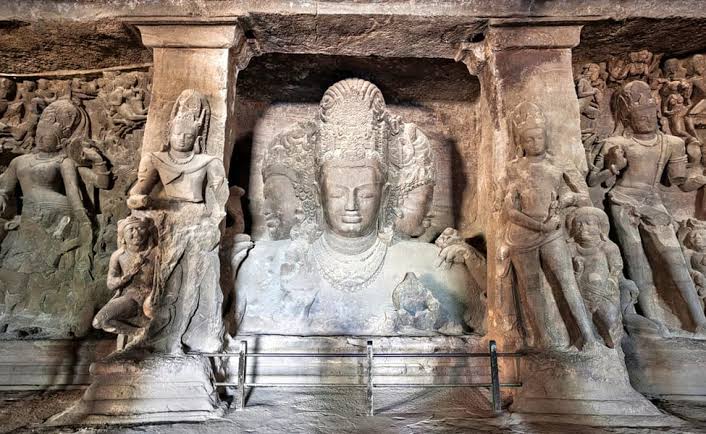
About The Elephanta Caves
Elephanta Caves contain rock cut stone sculptures that show syncretism of Hindu and Buddhist ideas and iconography.The caves are hewn from solid basalt rock. Except for a few exceptions, much of the artwork is defaced and damaged. The main temple’s orientation as well as the relative location of other temples are placed in a mandala pattern.
The island is 2.4 km (1.5 mi) in length with two hills that rise to a height of about 150 m (490 ft). A narrow deep ravine separates the two hills, and runs from north to south. On the west, the hill rises gently from the sea and stretches east across the ravine and rises gradually to the extreme east to a height of 173 m (568 ft). Forest growth with clusters of mango, tamarind, and karanj trees cover the hills with scattered palm trees.
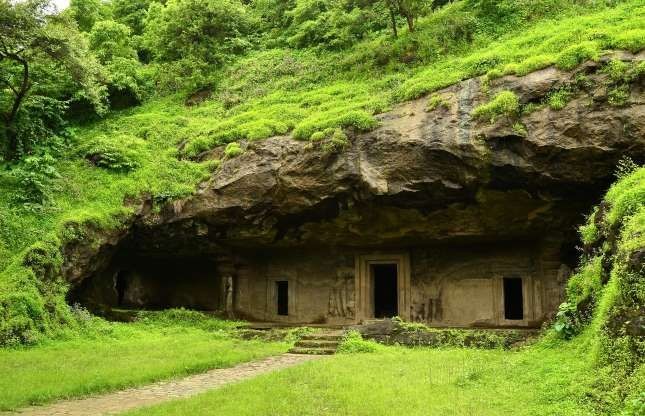
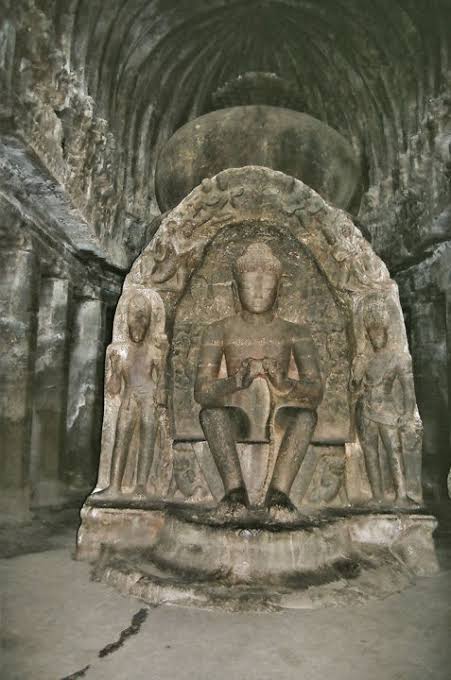
There are five rock-cut caves in the western hill and a brick stupa on the eastern hill. The eastern hill has two Buddhist mounds, and is called the Stupa hill. Close to the five western hill caves, are Cave 6 and 7 on the eastern hill. The most visited and significant cave is on the western hill and is called Cave 1 or the Great Cave, located about a kilometer walk up a steep graded uphill.
The fifteen large reliefs surrounding the lingam chapel in the main Elephanta Cave not only constitute one of the greatest examples of Indian art but also one of the most important collections for the cult of Shiva. Caves are the most magnificent achievement in the history of rock-architecture in western India. The Trimurti and other colossal sculptures with their aesthetic setting are examples of unique artistic creation.
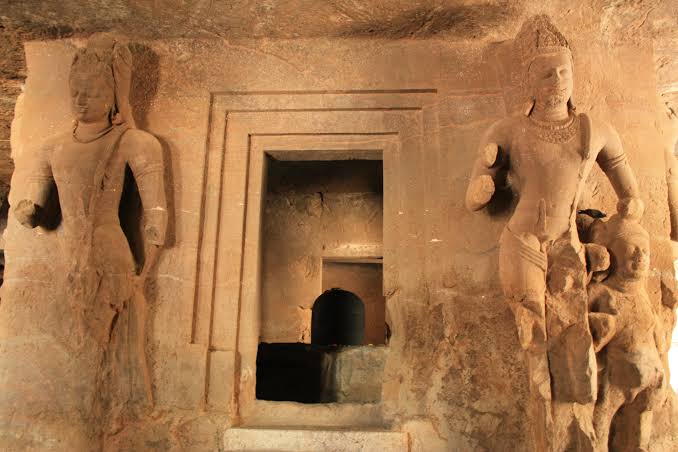
History
The ancient history of the island is unknown in either Hindu or Buddhist records. Archeological studies have uncovered many remains that suggest the small island had a rich cultural past, with evidence of human settlement by possibly the 2nd century BC.The Elephanta site was first occupied by Hinayana Buddhists, before the arrival of the Brahmans to the island, to raise a large stupa to the Buddha with seven smaller stupas around it, probably around the 2nd century BCE.Coins of the Kshatrapas (Western Satraps) dating to the 4th century CE were found on the island.
Colonial era historians suggested that the caves were built by the Rashtrakutas in 7th century or after, a hypothesis primarily based on some similarities with the Ellora Caves.This theory has been discredited by later findings.
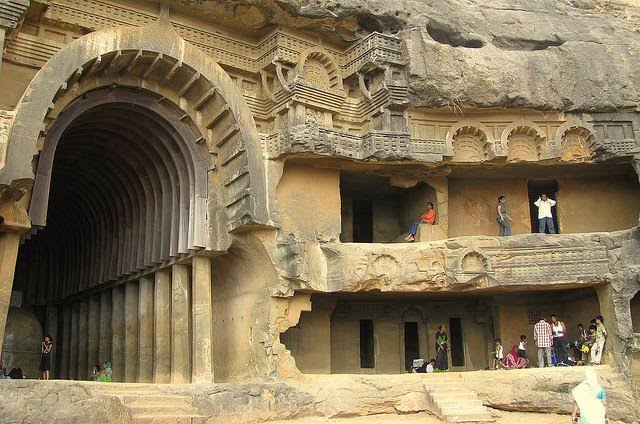
According to Charles Collins, the significance of the Elephanta Caves is better understood by studying them in context of ancient and early medieval Hindu literature, as well as in the context of other Buddhist, Hindu and Jain cave temples on the subcontinent.
Origin of Its Name
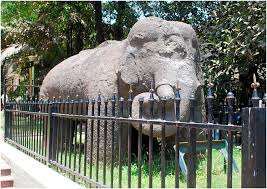
The local Marathi folks popularised this island as Gharapuri, but Elephanta became common parlance after the Portuguese took over the land from the Gujarat Sultanate in 1534 and named it so after the massive rock-cut elephant statue that stood sentinel over the sea. The colonisers identified the structure as a landmark to dock their boats and to also tell it apart from the other smaller islands on the Arabian Sea. You can no longer find this monolithic elephant statue here as it was damaged in an attempt to move it to England. In 1914, it was reassembled by Cadell and Hewett and placed in the Jijamata Udyaan, a zoo and garden in Byculla, Mumbai, where it stands today.
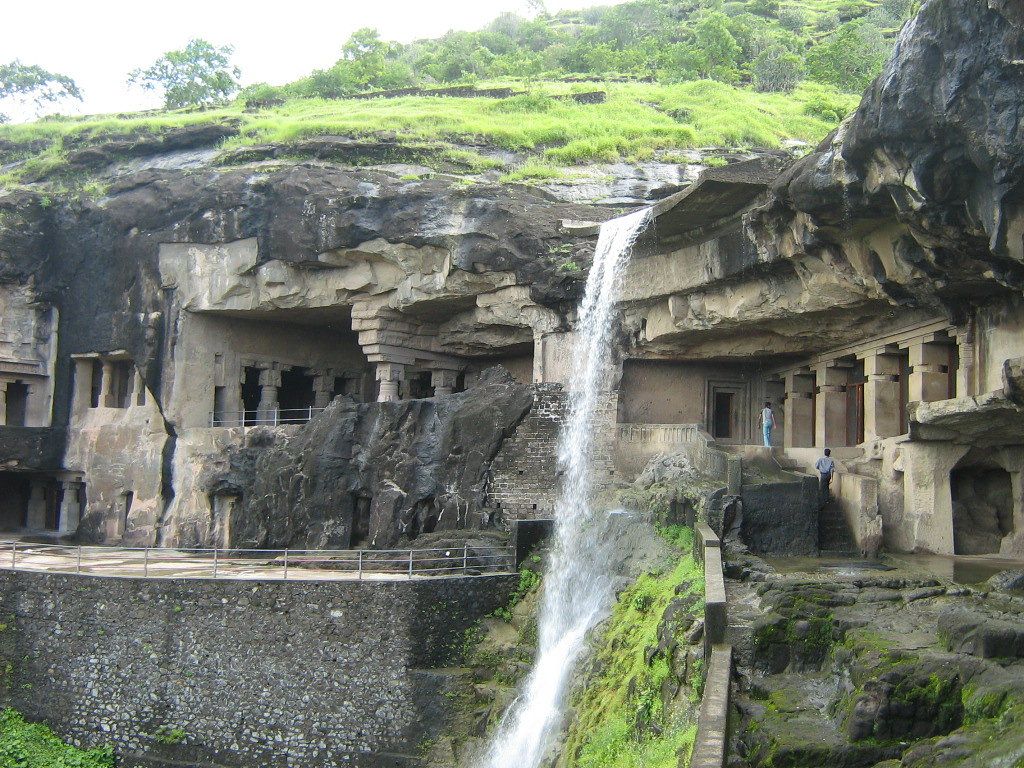
Guide To Understand The Caves
Cave 1 or the Great Cave: After disembarking from the ferry, you can either walk the one kilometre distance to the cave site or take a toy train from the pier to the base of the hill. Further, you need to ascend a fleet of 120 steps to the hilltop on which the Great Cave is perched. The architecture of the cave seems to have been borrowed from that of a typical Buddhist Vihara (monastery), with a central court and several pillared cells. For a depth of 39 metres from front to back, it has a remarkably small main entrance. Although, there are two side entrances each from east and west. An ode to Shaivism, the temple complex celebrates the various forms and manifestations of Shiva with some larger-than-life sculptures. The centerpiece of the Grand Cave is the Trimurti, and also the most intriguing. Facing the north entrance is the Trimurti sculpture carved in relief on the cave wall depicting Shiva with three heads, also called Sadashiva. The three heads each are symbolic of the holy trinity, translating into creator, preserver and destroyer. The Gangadhara is another depiction of Shiva just to the right of the Trimurti. Here, in extreme detail, Shiva is shown bringing the Ganges down from the heavens to serve mankind, while Goddess Parvati looks complacent standing beside him. The carving of Ardhanarishvara to the east of the Trimurti is in a dilapidated state. It portrays the coming together of energy and power by showing the unification of Shiva and Parvati with the upper half as a feminine form and the lower, masculine. Nataraja, Yogishvara, the wedding of Shiva and Parvati are among the other popular themes Cave 1 delves into.
Canon Hill for Caves 2 to 5: Cave 2 was ravaged and restored in the 1970s. It has four square pillars and two small cells. Cave 3 carries on the mandapa architectural legacy with pillared recesses and inner chambers. The central door holds a damaged shrine, believed to be that of Shiva. Next in line is Cave 4 also in a ruinous state with a rambling verandah bereft of pillars. Though, there is a lingam in the shrine at the back of the structure. Cave 5 simply exists with no discernible reference to any tenet in history.
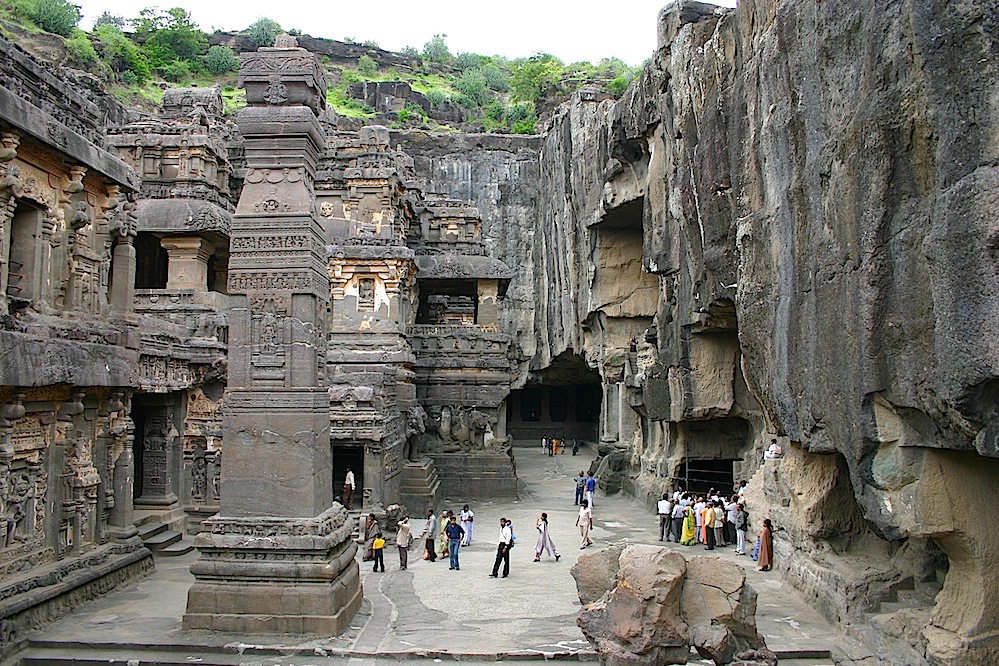
Stupa Hills for Cave 6 and 7: Cave 6 on the eastern hill across from Cave 1 is also called Sitabai cave temple. The porch has four pillars, three chambers and a central shrine. No adornments from the times gone by remain in the cave, barring a frieze with some lion figures carved on it. Cave 6 is significant historically owing to its conversion and use as a church during the Portuguese rule. There isn’t much left of Cave 7 too save for a small verandah which probably accommodated three chambers. The dry pond beyond Cave 7 was probably a Buddhist water tank due to the presence of Buddhist cisterns on its shores. Close to the cistern is a huge mound identified as a Stupa that dates back to 2nd Century BCE.
Defacement and Restoration of the Caves
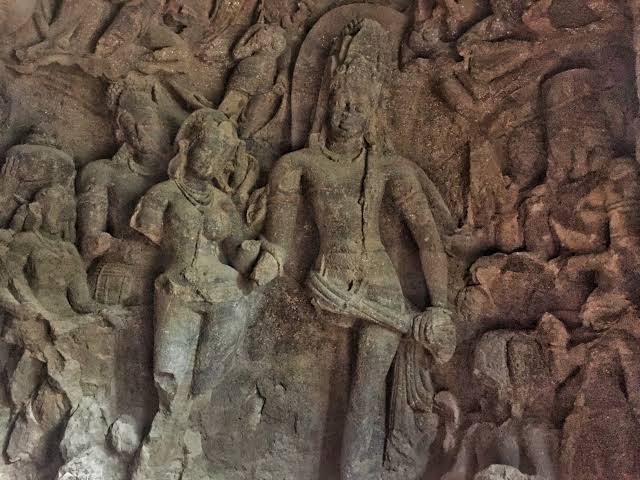
Over centuries scholars have argued over who defaced the structures most, but their findings remain inconclusive to this day. Some schools blame it on the Gujarat Sultanate period for dealing a blow to the artwork and decorations across the caves, and there are others who find the Portuguese soldiers guilty of using the caves as a firing range and the statues for target practice. A few experts exonerate the Muslim rulers and the Portuguese from any defacement the caves suffered, for they were believed to have plastered the artwork and even the caves. These experts believe that the Marathas expedited the impending doom of the caves by deliberately damaging the artwork in the 17th century. In the 1970s, the Indian government made major restoration efforts and gave the heritage site a new lease of life. Today, the Archaeological Survey of India (ASI) manages the site in terms of constructing support structures and maintaining the on-site museum and visitor facilities.
Other things to see in Mumbai: Marine Drive, Juhu Chowpatty, Sanjay Gandhi National Park, Kanheri Caves, Dharavi, Film City.
We hope you liked our blog. Please Like Share, Comment and Follow our blogs. Stay tuned for more information about the travel destinations and don’t forget to follow our social media handles !
Thank You!
Team Travelographer

 Travelographer