
Stupa Visiting Timing: 6am to 6pm
How to Reach: By Air or rail to Bhopal which is well-connected with many other cities of India and then by road to Sanchi by bus, cabs and private cars provided by different tour operators. Sanchi can also be reached by road from Vidisha (10 km) and Indore (232 km)
Entry Fees:
- Indian tourists – ₹40
- Tourists from SAARC and BIMSTEC countries – ₹40
- Foreigners – ₹600
- Free entry for children under the age of 15
The ticket counter is a stone’s throw from the main road, but it is always better to make an advance booking online and arrive at the site with better preparedness. The ASI website also accepts online bookings for various monuments under its purview.
Visiting Days: The monument complex remains open on all days of the week.
Architectural Style: Buddhist Art and Architecture
Location: Sanchi Town, Raisen District, Madhya Pradesh 464661
Best Time to Visit: The best time to visit Sanchi is from November to March, as the temperature of this place is quite high during summers. Visiting Sanchi in monsoon will also give you a majestic experience, though you may find difficulty in travelling around the city.

About the Sanchi Stupa
One of the oldest surviving stone structures in India and a specimen of Buddhist architecture, the Great Stupa at Sanchi will help you join the dots between one of ancient India’s most powerful rulers, King Ashoka, and the subsequent rise of Buddhism. This hemispherical stone dome however synonymous with Sanchi, when originally commissioned by Emperor Ashoka in the 3rd Century BCE, was a simple brick structure with the relics of Lord Buddha placed in a central chamber. About 46 kilometres northeast of Bhopal in Madhya Pradesh lies the Sanchi Stupa, a UNESCO World Heritage Site, and a landmark structure in tracing the evolution of Indian architecture starting with the Maurya period.
One of the best conserved Stupas, the Great Stupa at Sanchi with its four ornamental toranas or gateways lures visitors from all over the world to this day who spend hours at the site marvelling at this Buddhist architectural masterpiece, and the richness of its sculptures. The great Maurya ruler, Ashoka, who reigned over the entire subcontinent between 268 and 232 BCE, can be credited for laying the foundation of a typical Vihara (Buddhist monastery) architecture as evident in Sanchi, a trend that flourished through the centuries until the 12th century AD.
History
Construction, Destruction and Reconstruction
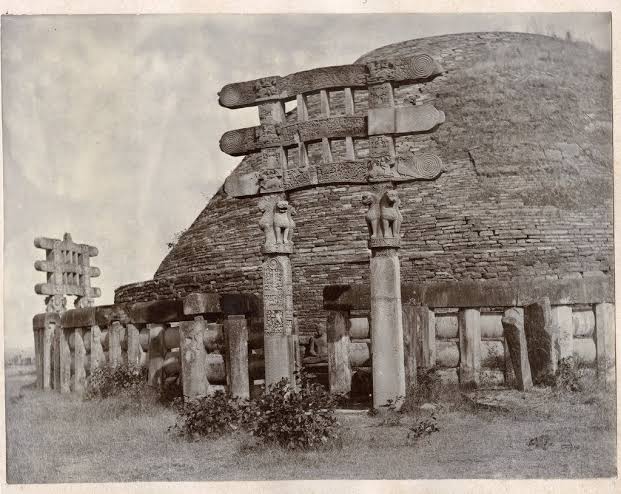
When Ashoka built the Great Stupa, he had at the nucleus a huge hemispherical brick dome covering the relics of Lord Buddha, with an elevated terrace surrounding the base, a balustrade, and a chatra or stone umbrella on the top to indicate high rank. The current structure goes back to the Shunga period when the brick was replaced with stone and the diameter of the dome was nearly doubled. The Shunga Empire was founded in the north after Pushyamitra Shunga, an army general in the Mauryan Empire killed the last ruling Maurya, Brihadratha Maurya in 185 BCE. Experts assert that the Stupa was pillaged in the Shunga reign, an instance associated with the growing power of Pushyamitra, and went on to be reconstructed later by his son, Agnimitra. However, unlike the more rounder brick structure, the stone one has a flattened top surmounted with a three-tier chatra symbolic of the Wheel of Dharma. A flight of double staircase was introduced to let one walk around the sacred dome and get to the elevated rounded drum that came to be the seat of the structure.
The Iconic Toranas of the Great Stupa
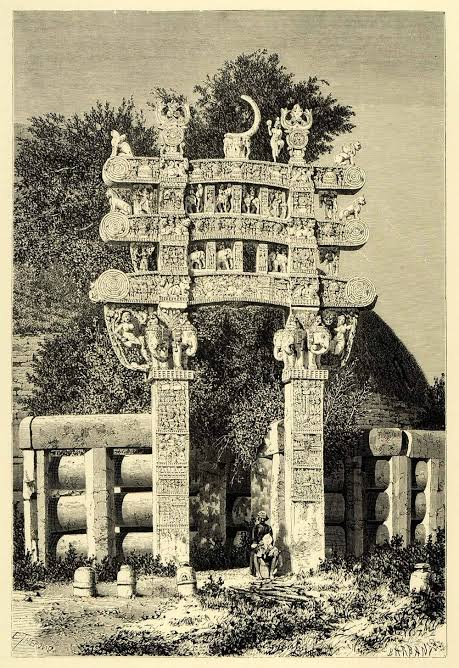
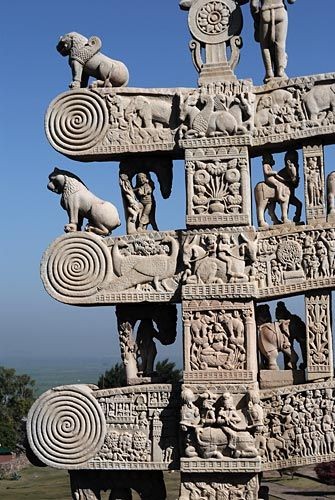
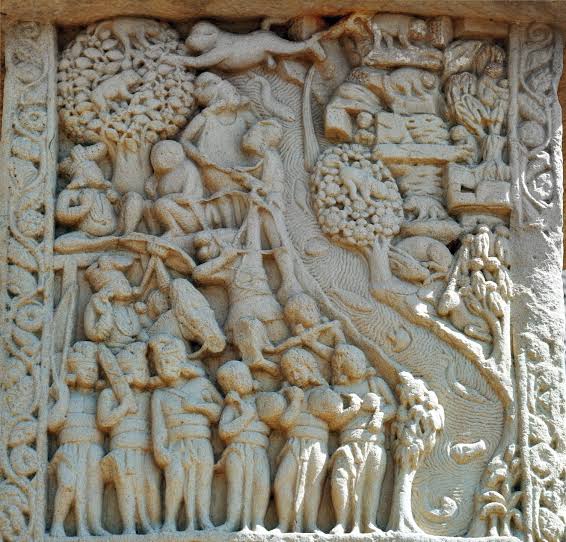
Early inscriptions indicate that the extremely ornate gateways on all four directions and the heavily carved balustrade running the circumference of the Stupa were added to the original structure in the 1st Century BCE in the reign of the Satavahanas. Take a closer look at the gateways and the balustrades and you will witness a spectrum of illustrations revolving the life of the Buddha including tales from Aryasura’s Jatakamala. It is interesting to note the way symbolic manifestations of the Buddha have been used across the carvings in the form of tree or inanimate objects like wheels, thrones or footprints. Notice one of the Pillars of Ashoka in polished sandstone in the main torana, though only the bottom half of the pillar stands on the site. To look up the upper half you need to visit the Sanchi Archaeological Museum close by.
Other Monuments in the Sanchi Stupa Complex
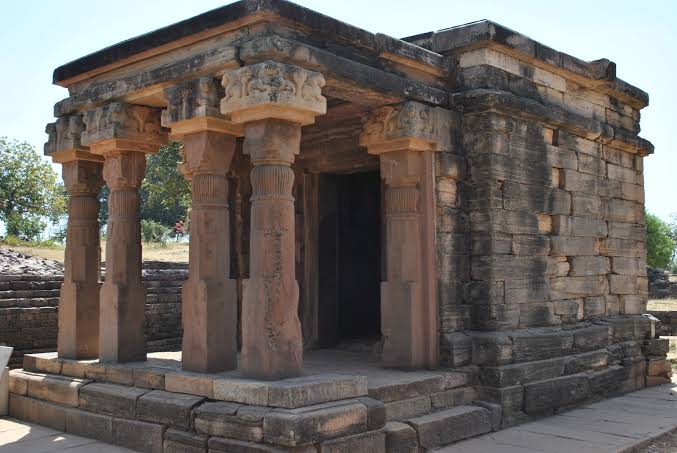
Temple 40: Partially dating back to 3rd Century BCE is one of the country’s first free-standing temples, the Temple 40. What makes the structure fascinating is the fact that it has vestiges going back to three different periods; the earliest one being from the Maurya dynasty with an inscription suggesting that it was built by Emperor Ashoka’s father, Bindusara. In its earliest design, the temple was constructed on a rectangular stone base that had to be reached by two flights of stairs lying to its east and west. By 2nd Century BCE, the rectangular platform was extended and a pillared hallway was created, of which only stumps survive today. A little shrine in a corner of the platform came up in the 7th or 8th Century by making use of the existing pillars.
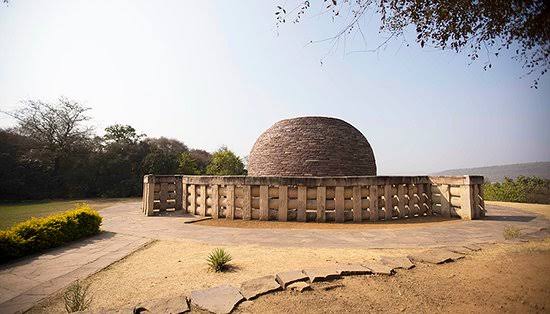
Stupa No. 2: Stupa no 2 came up in the Shunga rule in keeping with the stone casing and ground balustrade tradition of the Great Stupa. The detailing, the emphasis on Buddhism and the various Buddhist themes stand out in Stupa no. 2, and it is not without a reason that this stupa is billed ‘the oldest extensive Stupa decoration in existence’. The representation of Buddhist themes is particularly remarkable as you get to see the four events – Nativity, Enlightenment, First Sermon, and Decease – that defined the life of Buddha. Even the depiction of Jataka tales through carvings took root in this Stupa.
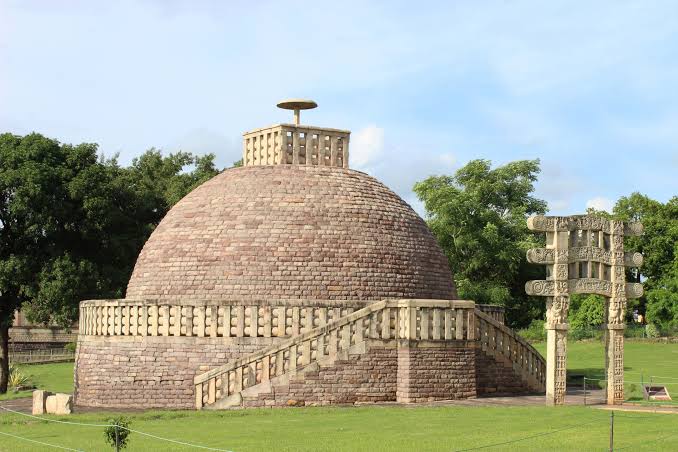
Stupa No. 3: This too came up in the Shunga period complete with the staircase and the balustrade. Relics of the disciples of Buddha, Sariputra and Mahamoggallana were placed here in Stupa no. 3. But this structure came up a little after Stupa no. 2 and the reliefs on the balustrade confirm this. However, it wasn’t the Shungas who built its single south-facing torana, but the Satavahanas in 50 BCE.
Sanchi Museum
Just as you descend the hill from the main Stupas site, you will notice a single-storeyed white building in a compound of tall trees and green gardens. This is the ASI Museum for Sanchi and was setup in 1919 by its then director general, Sir John Hubert Marshall, although the current building is a newer property acquired in 1966. The four galleries of the museum are a treasure-trove of relics from Sanchi’s Buddhist heritage and includes sculptural artifacts across several kingdoms that ruled the region. The museum is shut for maintenance on Fridays. The entry fee to this INR 5.
Restoration Works in the 19th century
General Taylor, a British officer was the first to document the existence of the Great Stupa in Sanchi in 1818. And by the time Sir John Hubert Marshall, the director general of Archaeological Survey of India (ASI) took up the task of restoring the ancient monument between 1912 and 1919, it had already suffered significant damage in the hands of treasure hunters and general trespassers.

Accomodation
To explore the Sanchi Stupa and the Sanchi Archaeological Museum, you can stay in Sanchi town at one of the budget hotels. Else pick a hotel in Bhopal city which has wider choices for board and lodging, and is a fairly easy commute to the Stupa site as well.


Thank you for reading this blog and hanging in till here. I will be sharing my such travel experiences and destinations in future so follow my blogs and stay connected. Dont forget to hit the Like button if you found my blog interesting. You can also comment down your views below and share it.
You can also support me by following my other social media handles. You can find out the link in the bottom.
Thank You !
Team Travelographer

 Travelographer